Эрдсийг эрдэнэст
Ирээдүйг өндөр хөгжилд
Ирээдүйг өндөр хөгжилд
Mining The Resources
Minding the future
Minding the future

By O. Dulguun
Twenty copper projects that could generate 4.1 trillion MNT in Mineral Resource Royalty (MRR) revenue for the state budget and attract 5.7 trillion MNT in investment have been placed on indefinite hold.
The key to advancing them was a long-awaited amendment to the Minerals Law potentially aligning Mongolia's copper Mineral Resource Royalty (MRR) with international standards, by reducing the tax burden. However, during the bill's first reading, Parliament decided to defer the reduction of the copper Mineral Resource Royalty (MRR) by three years, with the amendment set now to take effect on January 1, 2029.
The decision reportedly stemmed from the Mongolian People's Party (MPP) caucus in Parliament, which argued that no changes should be made to the copper Mineral Resource Royalty (MRR) until a new Investment Agreement is concluded with Entrée Resources, the holder of a mining license at the Oyu Tolgoi deposit.
At a time when global competition for copper investment is intensifying, what will be the consequences of Mongolia retaining its current royalty regime for another three years?
4.14 TRILLION MNT IN ROYALTY REVENUE FROZEN
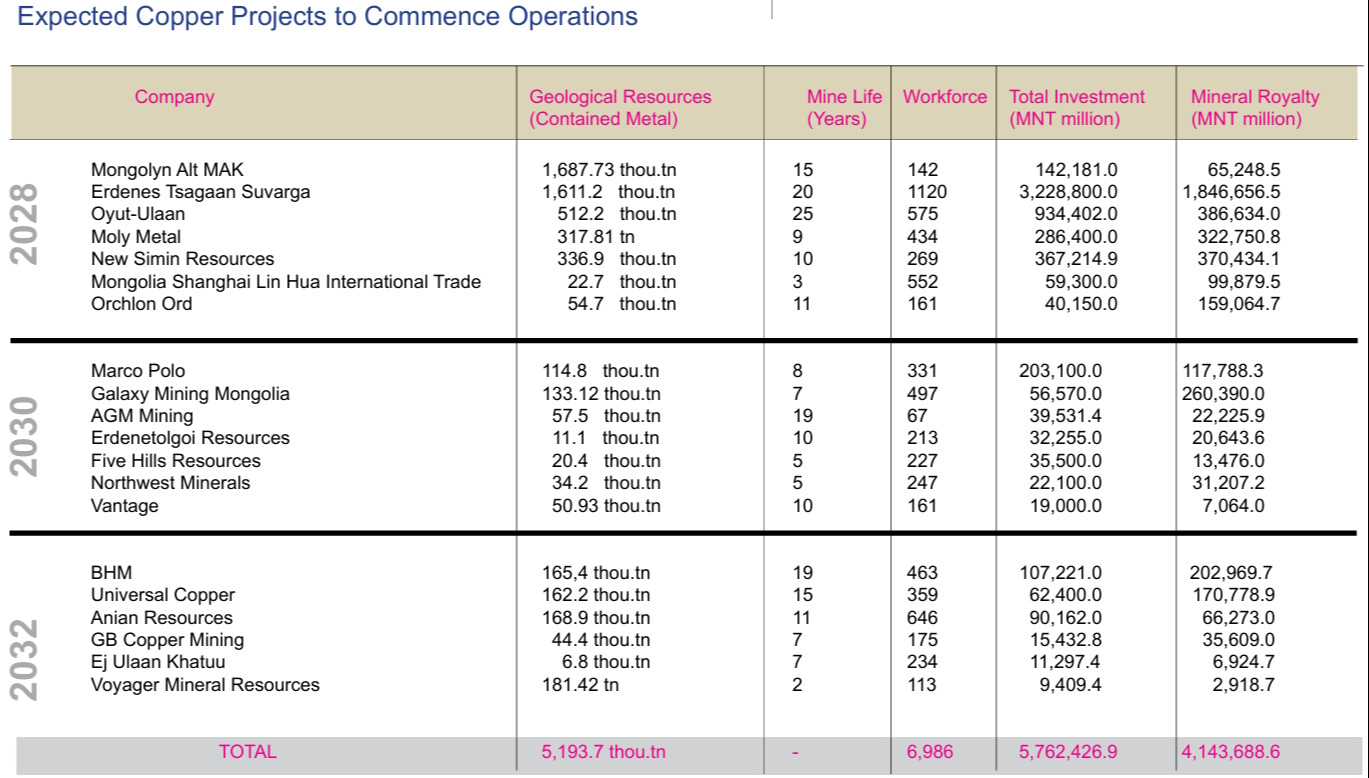
The projects would have brought copper deposits with geological resources totaling 5.2 million tonnes into production, created 6,986 new jobs, attracted 5.76 trillion MNT in direct investment, and generated 4.14 trillion MNT in Mineral Resource Royalty (MRR) revenue for the state budget.
Of the 20 projects, 87.4% of the total geological resources, equivalent to 4.54 million tonnes of copper, were ready to enter production in 2028, with 5.06 trillion MNT already invested. These included major domestic and foreign-funded projects such as Tsagaansuvarga (1.61 million tonnes), Oyut-Ulaan (512.2 thousand tonnes), New Simin Resources (336.9 thousand tonnes), and Oyu Tolgoi (54.7 thousand tonnes).
The projects expected to enter production in 2028 alone were projected to generate 3.6 trillion MNT in Mineral Resource Royalty (MRR) revenue and create 3,353 jobs. Meanwhile, the future of seven projects scheduled to enter production in 2030, including those of Marco Polo, Galaxy Mining, and AGM Mining, as well as six additional projects planned for 2032, has also been cast into uncertainty.
Ministry of Industry and Mineral Resources' detailed analysis
FLEXIBLE TAXATION
According to the analysis, making the tax system more flexible by aligning the tax burden with international norms, in line with the economic principle of the Laffer Curve, would enable projects to overcome financing bottlenecks and increase Mongolia's copper production by 32% over the next decade.
The increase in actual budget revenue resulting from a more flexible progressive royalty structure is illustrated by the following comparison:
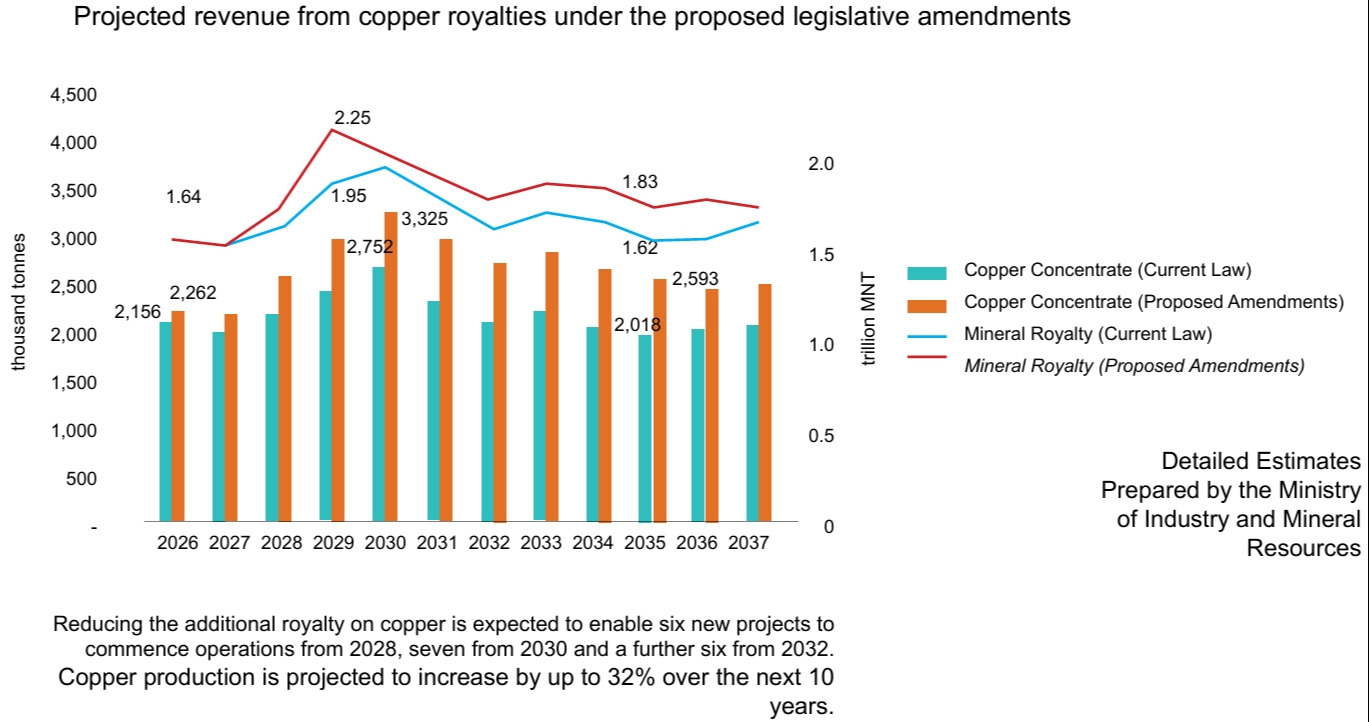
If the current law remains unchanged, Mongolia's copper concentrate production is projected to decline from 2.15 million tonnes in 2026 to 2.01 million tonnes by 2035. By contrast, under the proposed amendments, production would have reached a record 3.32 million tonnes in 2029.
MRR revenue is likewise projected to decline, falling to 1.62 trillion MNT by 2035 if the current law remains unchanged. By contrast, under the proposed amendments, although the royalty rate would be lower, the sharp increase in production volumes would boost MRR revenue to 2.25 trillion MNT in 2029 600 billion MNT more than under the current regime. By 2035, MRR revenue would remain stable at around 1.83 trillion MNT.
Quantitative comparison of how a more flexible royalty rate structure would increase actual budget revenue:
FALLING BEHIND IN GLOBAL COMPETITION
Today, leading copper-producing countries such as Australia, Brazil, and Indonesia maintain stable base Mineral Resource Royalty (MRR) rates of between 2% and 5%.
Chile, the global benchmark for the copper industry, overhauled its Mineral Resource Royalty (MRR) regime in 2024. Companies producing more than 50,000 tonnes of copper annually are subject to a 1% royalty on gross sales revenue. However, if a company operates at a loss in a given year, it is exempt from paying this 1% royalty. In addition, Chile has adopted a flexible, progressive royalty system under which companies pay an additional 8% to 26%, depending on their operating profit.
Chile has gone a step further by capping the combined burden of corporate income tax, withholding tax, and the Mineral Resource Royalty (MRR) at 46.5% of a company's pre-tax profit, providing investors with greater certainty over their future tax obligations.
As a result, Chile generates an additional $1.35 billion in tax revenue each year, of which $450 million is allocated directly to mining regions, local development funds, and infrastructure.
By contrast, Mongolia applies a 5% base Mineral Resource Royalty (MRR), supplemented by a progressive royalty linked to increases in market prices. As a result, the effective royalty rate can rise to as high as 35%. This effectively imposes a royalty burden on international investors that is three to six times higher than that of competing jurisdictions.
The proposed amendments provided that when the market price of copper exceeded $9,000 per tonne, the progressive Mineral Resource Royalty (MRR) on raw ore exports would be reduced from 30% to 15%. The maximum progressive royalty on copper concentrate would similarly reduce from 15% to 5%, while refined copper products would be subject to just 2.5%.
In other words, the proposal used the tax system to discourage the sale of raw ore while providing a clear incentive in the form of MRR relief for domestic producers to manufacture copper concentrate and refined products.
However, with the proposed amendments stalling in Parliament this spring, Mongolia will remain a raw material exporter while retaining, until 2029, a rigid royalty regime that deters investment by imposing a tax burden several times higher than that of competing countries.