Эрдсийг эрдэнэст
Ирээдүйг өндөр хөгжилд
Ирээдүйг өндөр хөгжилд
Mining The Resources
Minding the future
Minding the future
By T. Byambanaran
GROUNDBREAKING CEREMONY HELD FOR A NEW MINING-DRIVEN SETTLEMENT ZONE
As Mongolia's mining sector continues to develop, new settlement areas supported by infrastructure and centered on mining activities have been emerging in rural regions. One of the most recent examples is the "Gurvantes New Settlement Zone" in Umnugobi Aimag.
On June 9, 2026, "Mongolyn Alt" (MAK) LLC held a groundbreaking ceremony for a new settlement zone in Gurvantes Soum, Umnugobi Aimag. The event marked the launch of a comprehensive development project comprising 1,500 housing units, as well as schools, kindergartens, hospitals, sports facilities, commercial and service centers, and green spaces, forming an integrated residential area.
Company representatives stated that the project aims to provide a favorable living environment for miners, engineers, and technical staff working in the area, enabling them and their families to live stable and comfortable lives. It also seeks to support labor market stability and improve local social and economic infrastructure.
According to B. Nyamtayshir, Chairman of the Policy Council of MAK LLC, approximately 2,000 employees are currently working in Gurvantes Soum, and this number is expected to increase as development expands. He emphasized that under such conditions, not only employment opportunities but also a suitable living environment has become essential.
The total investment of the project amounts to $55 million to be implemented over three years.
Today, this region has become an important hub for Mongolia's exports. In particular, business entities operating in and around Gurvantes account for approximately 40% of Mongolia's coal exports to the People's Republic of China.
This settlement area is a continuation of mining-driven urban development observed in cities and towns such as Erdenet, Khanbogd, and Tsogttsetsii.
The MAK Group stated that it plans to establish settlement zones beyond Gurvantes in the future, including in Sainshand city and Dalanjargalan soum of Dornogobi Aimag, as well as in Zuunmod city of Tuv Aimag.

Thus, while mining-driven settlement zones are expanding in Mongolia, a range of human rights and environmental issues inevitably accompany them.
It is clear that the existence of mining-based settlements and mining-dependent towns is directly tied to a single underlying factor: mineral resources. In other words, when these resources are depleted, such towns and settlements risk being abandoned, and their long-term future becomes uncertain.
The Organisation for Economic Cooperation and Development (OECD) define mining regions and mining-dependent cities as areas where a significant share of the economy, employment, and household income is directly dependent on mineral extraction.
Therefore, the greatest challenge facing mining-based towns and settlements is not so much "how to develop," but rather "how to sustain themselves once mining operations cease, and what will remain for residents after mine closure."
INFRASTRUCTURE DEVELOPMENT BRINGS A WIDE RANGE OF PRESSING CHALLENGES
One of the most visibly transformed areas in Mongolia due to mining influence is Khanbogd Soum in Umnugobi Aimag. The soum hosts major mining and investment sites, including the Oyu Tolgoi deposit, as well as the Tsagaan Suvarga copper and gold deposit to the northeast, the Kharmagtai deposit to the east, and the Tavan Tolgoi coal mine in Tsogttsetsii to the north. As a result, Khanbogd Soum lies at the center of some of Mongolia's largest mining operations, which are key contributors to the country's investment inflows and budget revenues.
A few years ago, Khanbogd was just an ordinary rural soum in the Gobi Desert. Today, however, it has undergone rapid transformation driven by the Oyu Tolgoi project. An international-standard airport, new schools and kindergartens built to global standards, residential complexes, and service centers have all emerged, making it one of the fastest-developing soums in Umnugobi Aimag-something immediately noticeable to any visitor.
Behind this development, the Gobi Oyu Development Support Fund has played an important role.
Established in 2015 through a partnership between Umnugobi Aimag. Khanbogd Soum, and Oyu Tolgoi LLC, the Fund receives annual funding of $5 million. The Gobi Oyu Development Support Fund plans to implement 15 new projects between 2025 and 2028, focusing on education, healthcare, environmental protection, and economic development.
In addition, under the Khanbogd Sourn Master Plan approved in 2022, development works have begun to transform the soum center into a modern settlement with an investment of $50 million.
Today, Khanbogd's development is not measured solely by physical construction. As highlighted in a report by Oyu Tolgoi LLC, the focus is on creating the foundations for a sustainable city.
However, the fact that the soum's development is driven by a single mining company is, in a sense, a risk.
If Khanbogd's main driver of development were to stop one day, it is essential to plan ahead with a long-term policy to ensure the momentum is not lost and that development continues sustainably.
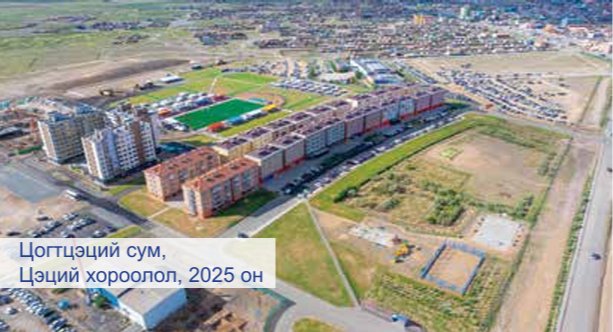
In contrast, while Khanbogd Soum has grown and transformed with funding from Oyu Tolgoi, Tsogttsetsii Soum has expanded alongside the Tavan Tolgoi coal deposits.
Three major projects are actively operating in the Tavan Tolgoi coal deposit area: the state-owned Erdenes Tavan Tolgoi, the locally owned Tavan Tolgoi mine-one of the earliest mining enterprises in Umnugobi Aimag-and the privately owned Energy Resources LLC. Since the commencement of operations at the Tavan Tolgoi coal deposit and the Ukhaa Khudag mine, the soum has become one of the fastest-growing settlements in Mongolia.
Over the past decade, infrastructure projects such as the Tavan Tolgoi-Gashuunsukhait railway, coal export roads, energy infrastructure including electricity transmission lines, and new residential districts have been commissioned. As a result, Tsogttsetsii has transformed from an ordinary soum into a major mining-based economic hub, distinct in both character and development trajectory.
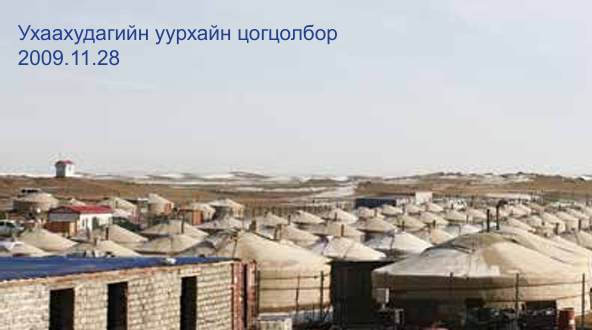
Energy Resources LLC began operations at the Ukhaa Khudag mine in 2009. Around the same period, it implemented a comprehensive solution for social infrastructure, including housing, schools, and kindergartens.
Within the Tsogttsetsii-Ukhaa Khudag complex, the "Tsetsi-1" and "Tsetsi-2" residential complexes were commissioned in phases starting in 2013.
In Tsogttsetsii Soum, while coal mining operations have driven market growth and accelerated infrastructure development, the impacts of extraction activities have been most strongly felt by local residents.
In particular, the negative effects of mining and heavy industry have had a severe impact on local herders. These effects are evident in several ways.
First, air pollution caused by mining operations has increasingly undermined the guarantee of a safe and healthy living environment for more than 20,000 people residing temporarily and permanently in the area.
Second, environmental degradation has become a serious issue, as stated by the soum Governor. Soil disturbance has led to the degradation of pastureland, while vegetation cover and the natural ecological balance have been significantly disrupted.
Water is the most pressing issue. Compared to other regions of Mongolia, the Gobi is an extremely water-scarce and fragile ecosystem. In this vulnerable environment, mining companies continuously extract vast quantities of groundwater, and the long-term consequences of such intensive use remain impossible to predict.
In this way, it is clear that a wide range of issues surrounding infrastructure and settlement zones will continue to emerge.
While establishing settlement areas to support mining operations and provide adequate living conditions for workers can be beneficial in some respects, it is essential to systematically address human rights concerns, environmental impacts, and potential climate risks through early warning mechanisms, transparent reporting, fair assessments, and continuous improvement at every stage of implementation.
In 5, 10, or even 20 years, when the lifespan of the mining operations sustaining these settlements comes to an end, it is essential to ensure that what remains is not a landscape of dust and abandonment, but a solid foundation for self-sustaining, long-term development.
FROM MINERAL RESOURCES TO A DIVERSIFIED ECONOMY
Studies by the Organisation for Economic Co-operation and Development (OECD) and the World Bank show that large-scale mining projects can create the conditions for new settlements and towns to emerge in remote areas by concentrating population, investment, services, and infrastructure.
Most mining regions and mining-based cities begin with just a few households and a limited number of jobs. Once major mines are operational, not only mine workers but also suppliers, transport companies, maintenance services, retail businesses, hotels, restaurants, and food service providers begin to establish themselves in the area.
As a result, thousands of direct and indirect jobs are created, significantly accelerating population movement and migration into these regions.
Canada's Sudbury is one of the world's well-known examples of a mining-based city with a rich industrial history. Nickel, copper, and precious metal deposits were discovered in the region, and the first mining settlements were established in the 1890s. Over four generations, miners have come to call this city their home.
Known as the "Nickel Capital of the World," Sudbury was once almost entirely dependent on mining. The Sudbury Basin contains the world's second-largest nickel reserves and is one of the few regions that produce Class 1 nickel, which is essential for electric vehicle battery manufacturing.
However, as the structure of extraction began to shift, city authorities started directing mining revenues toward education, research, and innovation.
A similar trajectory has been followed by mining towns in Australia's Pilbara region.
OECD studies highlight that Pilbara's economic development has been built on the mining sector. Supported by vast iron ore reserves, towns such as Karratha, Newman, and Port Hedland have emerged in the region.
These settlements were initially established to support mining operations, but over time they expanded into permanent towns with housing, schools, hospitals, and commercial and service centers.
Today, Port Hedland has become one of the world's most important iron ore export ports.
The common feature of these cities is that they have diversified their economies using mining revenues. In other words, the mining sector serves as a bridge for the development of other essential industries.
When combined with sound policy and planning, mining can provide the necessary conditions for the emergence of new hubs in logistics, trade, services, and manufacturing, as clearly demonstrated by the examples above.
ON THE OTHER SIDE OF THE COIN...
However, not every mining-dependent city has followed such a positive trajectory. Across the world, there are numerous examples of once-thriving mining towns that have since been abandoned and depopulated.
Chile's Chuquicamata is a town built around one of the world's largest open-pit copper mines. At its peak, around 25,000 people lived there. However, due to mine expansion and severe environmental pollution, residents were relocated, and by 2007 the town had been completely abandoned.
Today, only abandoned mining facilities and empty houses remain, standing as silent reminders of a once-active settlement.
Similarly, in the western United States, many towns built around gold and silver mining have lost their populations once natural resources were depleted.
Places such as Bodie and Rhyolite, which once had thousands of residents, are now abandoned "ghost towns" visited mainly by tourists. Specifically, between 1877 and 1882, Bodie had a population of around 8,000 people and was experiencing rapid growth, during which more than $38 million worth of gold, silver, and other precious metals were extracted. Today, the California Gold Rush and the era of intensive gold mining are long past, leaving behind around 200 deserted wooden structures in the area.
Ultimately, the success of mining-dependent cities should not be measured by the volume of ore extracted, but by how sustainably they are able to survive long after mining operations cease.
The greatest risk facing mining-dependent settlements is an economy built on a single pillar. When local revenues, jobs, and business activities all depend on a single mine, vulnerability to market fluctuations becomes significantly high.
In Mongolia's case, both existing and newly planned mining-based settlement zones must follow international best practices to ensure sustainable development. This will have a direct and visible impact on people's livelihoods, the environment, and the national economy.