Эрдсийг эрдэнэст
Ирээдүйг өндөр хөгжилд
Ирээдүйг өндөр хөгжилд
Mining The Resources
Minding the future
Minding the future
By A. Khaliun
The construction of the cross-border railway connecting Gashuunsukhait and Ganqimaodu ports began in June 2025. This is the second cross-border railway to be built between Mongolia and China in 70 years, following the Zamiin-Uud-Erenhot railway established under the 1955 agreement between the two countries.
On March 13-14, a delegation of officials led by Minister of Road and Transport B. Delgersaikhan visited the construction site to inspect progress and oversee operations.
The cross-border railway connecting the Gashuunsukhait and Ganqimaodu ports, the main outlet for Mongolia's coal exports, is being carried out with Mongolian Railways JSC as the project owner, China Railway Construction Corporation (CRCC) as the contractor, and Tavantolgoi Railway LLC responsible for project supervision.
The government has set a goal of increasing foreign currency earnings by boosting coal exports. To ensure that the cross-border railway project proceeds without delays, Prime Minister G. Zandanshatar tasked Minister of Road and Transport B. Delgersaikhan with resolving any Mongolia-related issues on-site and overseeing the smooth continuation of construction.
The Gashuunsukhait-Ganqimaodu railway will be 32.6 km long, featuring both 1,520 mm broad-gauge and 1,435 mm standard-gauge tracks, and is designed as a freight transport network with an annual capacity of 40 million tons. Of this, 19.5 km comprises the main railway line, while the remaining sections-including single- and double-span bridges ranging from 7 to 34 meters in height, a border control center, and technological facilities-together form a comprehensive infrastructure complex.
The construction site within the border zone has been designated as a special-purpose area restricted by both countries, with official notes exchanged through the Ministry of Foreign Affairs. In addition, the temporary regulations for working in the restricted zone were reviewed by the Government of Mongolia and approved through a government resolution. Minister B. Delgersaikhan presented these regulations to the contractor's representatives during a meeting.
The CRCC corporation has requested an additional 51 billion MNT in funding for the cross-border railway project.
At the border's zero point between the two countries, where construction is actively underway, the bridge piers are already visible rising from the ground. Work has begun on the Chinese side, and according to the project design, all 34 piers on China's territory have been completed. On the Mongolian side, out of the 284 planned piers, two have been erected so far, and assembly of a third pier is currently in progress. Starting in June, cross-beam installation from the Chinese side is scheduled to begin on these piers.
A meeting between the Mongolian and Chinese sides on the progress of the cross-border railway project was held at the joint border point within the restricted border zone. Representatives from CRCC Corporation, including Project Manager Wang San Tao and the project team, attended the meeting.
"During the past period, by thoroughly preparing the construction groundwork, we have achieved 10% project completion. The year 2026 will be the peak of construction, with a target of reaching 82% completion. In 2027, we plan to complete the remaining work and operate a trial train in April," reported Kh. Purevjargal, CEO of Tavantolgoi Railway LLC.
Minister B. Delgersaikhan stated, "The government is paying special attention to the construction of the cross-border railway. The contractor has provided all necessary materials and preparations for the project, including sand, gravel, rebar, as well as geodetic and geological groundwork.
Based on the contractor's inspection and review, the government resolution granted permission to use commonly occurring minerals, such as sand and gravel, from the areas they proposed."
He said, "The most important factor is the workforce. Once visas are issued for 1,280 Chinese workers, they will be able to participate in construction on Mongolian territory. The issue of these work visas, requested by CRCC Corporation, was resolved at the government meeting on March 4, 2026. Following official approval, officers from the Immigration Agency of Mongolia's Umnugobi branch will enter the border zone to issue visas to the Chinese workers. This will ensure that construction work can continue without interruption."
The total project budget is 902 billion MNT, and the contractor has proposed a budget increase. Since the signing of the contract, factors such as fluctuations in the exchange rate, rising labor costs, and increases in the prices of other construction materials have led CRCC Corporation to request an additional 51 billion MNT. During the meeting, representatives from the Chinese side inquired about how this matter was being addressed.
In response, Minister B. Delgersaikhan said, "The Government of Mongolia has established a working group tasked with studying and deciding on adjustments to the project's financing. I lead the working group, which also includes the Ministers of Finance, Foreign Affairs, and Industry and Mineral Resources, as well as other officials. The working group has held its initial meeting and will convene a second meeting next week to present its recommendations to the government. In accordance with Mongolia's Law on Tenders, we are discussing arrangements that would allow additional costs to be paid once project completion reaches 15%."
The cross-border railway project manager, Wang San Tao, said, "On the project site, we are using high-capacity machinery and equipment that meet standard requirements. Construction is proceeding in an orderly manner according to the plan. The installation of the main structural bridge piers has been fully completed. The piers are among the most time-consuming tasks. In 2026, we will carry out the bridge construction work. Our personnel have already arrived on the Chinese side of the border. Once visas are issued, allowing them to work on Mongolian territory, we are ready to begin."
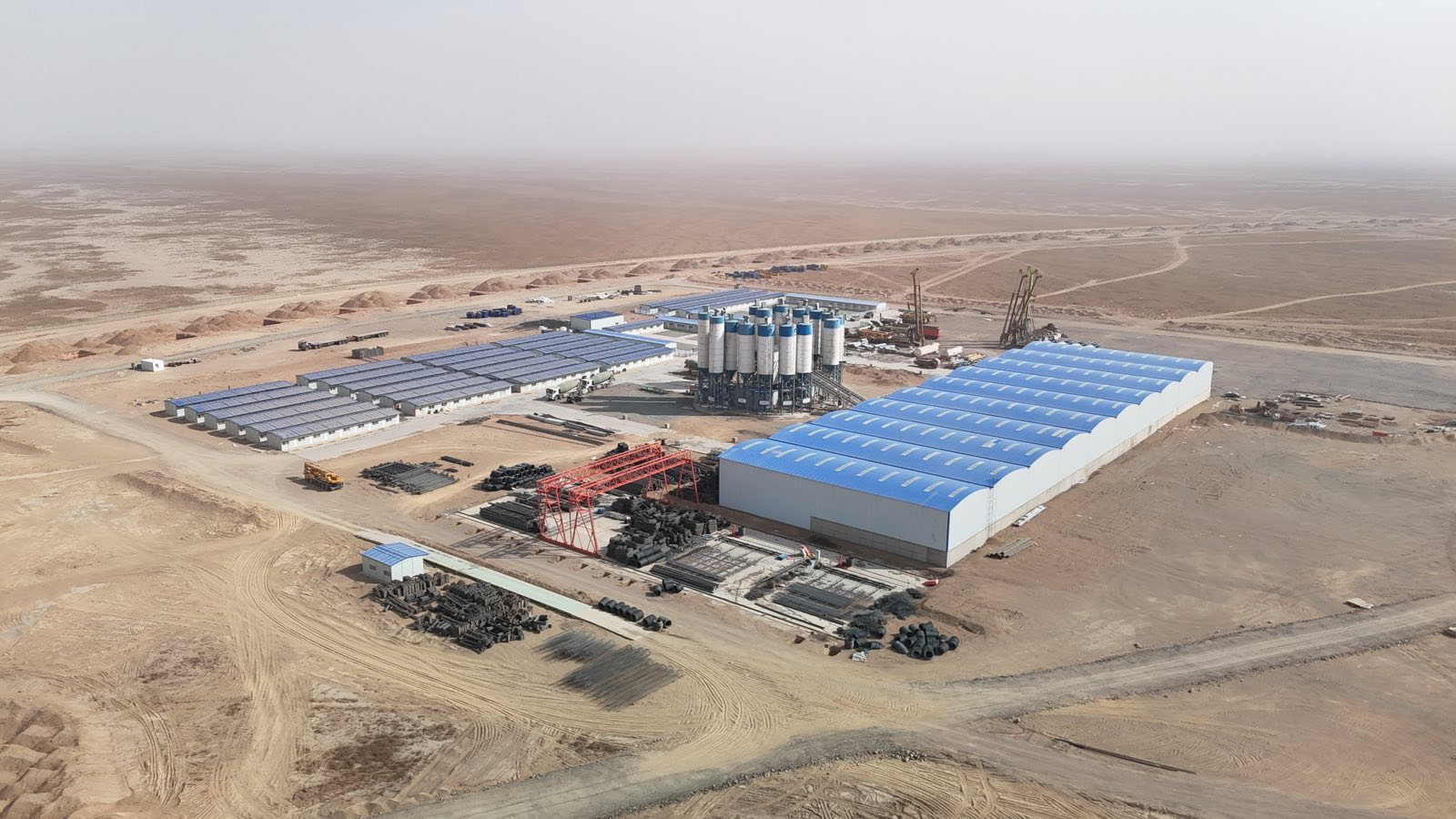
On the project site, the piers connecting the two countries have begun to be installed. Meanwhile, on the Chinese side of the border, supporting infrastructure has been put into operation to prepare for construction, including a cross-beam fabrication plant, a facility for steam-drying the cross-beams, and a yard for rebar preparation.
A total of 1,280 workers from China will participate in the project. According to the contract, Mongolian companies will handle approximately 30% of the total project work, providing temporary employment for around 300-400 Mongolian workers. At the site that will serve as a cross-border railway point, more than 30 facilities will be constructed, including worker accommodation, sanitation facilities, and a locomotive staging yard, all of which will be carried out by Mongolian companies. Currently, two Mongolian companies have already begun work.
From the pier displaying the Mongolian national flag and onward, the site lies on Mongolian territory, and construction on the Mongolian side is scheduled to begin this spring. The tallest of these piers reaches 34 meters, tapering to 7 meters at either end. To ensure the load-bearing capacity and stability of each pier, 12 piles, each 1 meter in diameter, were driven 35-41 meters deep beneath it. After proper reinforcement, on-site rebar was installed, concrete poured, and the above-ground piers erected. In other words, the foundation of each pier extends roughly 40 meters underground, making each structure approximately 70 meters in total height.
"Drilling 30-40 meters into the ground to install the pile foundations is very time-consuming. The main work carried out in 2025 was drilling, and on the Mongolian side, 60% of the 2,382 piles have been drilled. Rebar will now be installed in the drilled holes, followed by concrete pouring. In this way, last year we completed the most time-consuming key tasks," explained engineers from Tavantolgoi Railway LLC, who are supervising the project.
Mongolia exported 90 million tons of coal in 2026. Once the cross-border railway becomes operational, its throughput capacity is expected to increase, with a target of exporting 160 million tons. In particular, the Gashuunsukhait border crossing serves as the country's main coal export gateway, currently handling 40 million tons annually. When the railway is operational, transportation costs are expected to drop by 2-2.5 times, export volume is projected to increase by 30 million tons, and transport revenue is estimated to grow by $300 million.
"Even once the railway becomes operational, coal truck drivers will not be out of work. Road transport at this border crossing will continue simultaneously and without interruption," clarified Minister of Road and Transport B. Delgersaikhan.