Эрдсийг эрдэнэст
Ирээдүйг өндөр хөгжилд
Ирээдүйг өндөр хөгжилд
Mining The Resources
Minding the future
Minding the future
By Tugsbilegt
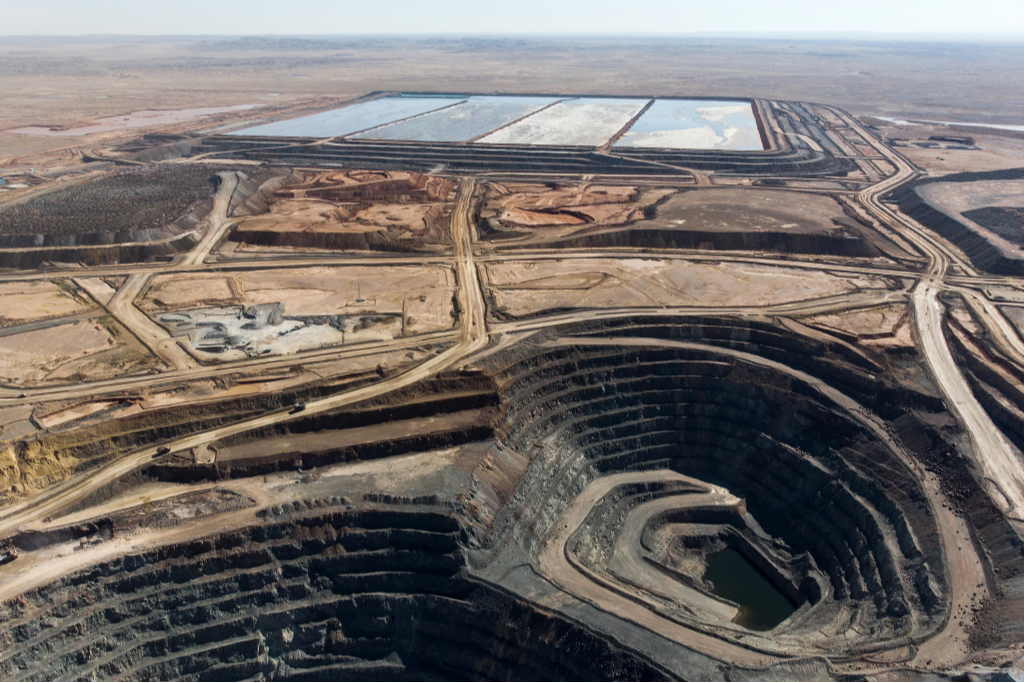
Mongolia's copper concentrate exports are expected to reach a record high of nearly $10 billion this year. At the same time, Oyu Tolgoi's tax and fee payments are expected to exceed $1 billion for the first time.
The Government's preliminary announcement on September 1, 2026, of the amount of Mongolia's first dividend from the Oyu Tolgoi project has answered a question that had been on the public's mind since the Naadam festival.
Finance Minister Z. Mendsaikhan said: "In June 2026, the Government held talks with Rio Tinto Group, the investor in the Oyu Tolgoi project. As Minister of Finance, I led the working group tasked with reducing the interest rate on the loan and determining the timing for reviewing the financing structure. As part of this work, the Government reached a number of concrete outcomes with Rio Tinto Group.
For example, the interest rate on the shareholder loan was reduced from SOFR + 6.5% to SOFR + 4%.
In addition, the period for reviewing the financing structure will be shortened from seven years to three years under the Investment Agreement. We have also decided that Mongolia will receive its first dividend from the Oyu Tolgoi project in 2026. As part of this process, Mongolians will receive their first dividend from Oyu Tolgoi before the end of 2026. The Government has formed a working group to work on this.
As a result of our negotiations with Rio Tinto Group, dividend revenue from Oyu Tolgoi has been included in the 2027 state budget. We have budgeted a minimum dividend of 3 trillion MNT.
Of this amount, 2 trillion MNT will be used to address pressing social, economic and infrastructure needs, while the remaining 1 trillion MNT will be allocated through the Sovereign Wealth Fund to provide citizens with support for healthcare, education and housing mortgages. The Government has submitted a draft law to this effect together with the draft budget."
The Prime Minister described the development as bringing Oyu Tolgoi's first dividend home to Mongolia and finally ending the 20-year-old discussion over when Mongolians would begin receiving dividends.
Oyu Tolgoi began exporting its first concentrate in 2013. The decision to pay its first dividend 13 years after sales began is therefore a significant milestone.
In 2022, the Mongolian Government's debt related to its 34% stake in Oyu Tolgoi was fully cleared. This can be seen as having established the legal basis for Mongolia to receive dividends. Under the Shareholders' Agreement, which stipulates that dividends can be paid only after the project's investment costs have been fully recovered, Mongolia would otherwise have had to wait until 2037 to begin receiving dividends.
The conditions for bringing forward the start of dividend payments had already emerged in recent years as Oyu Tolgoi's sales revenue increased substantially, accompanied by growth in profits.
Specifically, analysts estimate that Oyu Tolgoi will generate around $8 billion in revenue from copper concentrate exports in 2026, with free cash flow reaching $5 billion.
At the beginning of the year, however, Oyu Tolgoi had issued a relatively modest forecast, saying it expected to generate total revenue of $5.5 billion and free cash flow of $2.6 billion.
The company is now on track to significantly exceed those targets.
The Government's presentation of next year's budget states the following regarding dividend revenue from Oyu Tolgoi: "As part of negotiations with the investor in the Oyu Tolgoi project, an agreement was reached to reduce financing costs and bring forward the timing of dividend distributions. This creates conditions for increasing the tangible benefits to be received by Mongolia...
Of the dividend income from the state's share in the Oyu Tolgoi project, 2,000.0 billion MNT is estimated to be transferred to the state budget.
A further 1,000.0 billion MNT of the dividend income from the state's share in the Oyu Tolgoi project is expected to be transferred to the Sovereign Wealth Fund."
It is worth recalling that on March 9 this year, then-Prime Minister G. Zandanshatar expressed his intention to begin receiving dividends from Oyu Tolgoi this year during a meeting with a Rio Tinto delegation led by Katie Jackson, Chief Executive of Rio Tinto's Copper division.
The Government led by N. Uchral subsequently continued to pursue the policy of the former Prime Minister. Its continued efforts have now yielded results, turning the long-standing aspiration of receiving dividends from Oyu Tolgoi into reality.
There are now several points to clarify regarding the amounts involved. Oyu Tolgoi is expected to contribute around $600 million annually to the state budget through mineral royalties and other taxes and fees.
If dividend income of more than $800 million is added to this, the total amount contributed by the company to the state budget is expected to comfortably exceed $1 billion.
This means Rio Tinto can defend itself against criticism that it is paying very little tax while developing a major mineral deposit.
However, according to E. Bayasgalan, a former member of Oyu Tolgoi's Board of Directors, Mongolia's dividend could currently amount to $1.3–1.4 billion. This suggests that Mongolia is receiving around 60% of the dividend it is entitled to receive.
It appears that Rio Tinto has not been able to increase the dividend to its full potential because it has yet to repay the substantial loans associated with Oyu Tolgoi and fully recover its investment.
At the same time, there is uncertainty over the consequences of paying dividends, including potentially higher interest costs for the project, other unforeseen effects related to extending the loan repayment period, and the possibility of an arbitration ruling unfavorable to Mongolia.
Nevertheless, the decision to pay Mongolia its first dividend is undoubtedly a positive development. The fact that Rio Tinto's share price has shown no downward movement following the development suggests that investors do not appear to have reacted negatively to the move.
On the other hand, rather than distributing Oyu Tolgoi's dividends to citizens as cash payments, the Government appears set to channel the funds into major infrastructure projects and distribute part of them to individual citizens through the National Wealth Fund. However, the Government has said it will ask citizens how they would like the funds to be used.
In other words, there is a possibility that some of the allocation could eventually be converted into cash payments to citizens in an effort to gain political support ahead of the election year.
In addition, once the final dividend amount is determined and announced, the Government and Rio Tinto will face another important question: whether the majority of the benefits generated by Oyu Tolgoi are actually flowing to the Mongolian side.