Эрдсийг эрдэнэст
Ирээдүйг өндөр хөгжилд
Ирээдүйг өндөр хөгжилд
Mining The Resources
Minding the future
Minding the future
By O. Dulguun
The proposed amendments to the Minerals Law are expected to formally establish a critical minerals category and list, creating a new legal framework to support investment in the sector. The Ministry of Industry and Mineral Resources and the National Geological Survey have announced that preparations are underway to include 19 types of minerals on the country's critical minerals list.
Reflecting the transition to renewable energy and global market demand, the proposed list will primarily include copper, non-ferrous metals, and rare earth elements.
However, the geology and exploration sector—the foundation for implementing these policy reforms—has stagnated, continuing to limit the potential for major new discoveries.
Of the 2,817 valid mineral licenses nationwide, 1,778 are mining licenses, while only 1,039 are exploration licenses. The number of exploration licenses is nearly half that of mining licenses, indicating that the continuity of geological exploration has been disrupted and the pace of exploration has slowed.
Although the government has increased funding for basic geological surveys, investment from the state budget remains limited. Ultimately, it is clear that reviving the exploration sector will require attracting private investment.
Mineral exploration frequently faces local opposition due to a widespread perception that exploration inevitably leads directly to mining. The minister said the proposed amendments therefore include specific provisions to clearly distinguish the lower-impact exploration stage from mining, while also addressing environmental, social and governance (ESG) considerations and ensuring that socioeconomic benefits remain in local communities as projects transition to the mining stage.
By simplifying the exploration licensing process and making engagement with local communities more transparent and institutionalized, Mongolia could accelerate geological exploration for the next generation of strategically important deposits comparable to Oyu Tolgoi and Erdenet. By unlocking its vast reserves of strategic minerals such as copper, rare earth elements and lithium, the country could strengthen its position in the global critical minerals network and emerge as a key player in global supply chains.
Its geographic proximity to major Asian consumers such as China, South Korea, and Japan offers a significant advantage in reducing export costs and expanding strategic partnerships. Moreover, Mongolia has considerable potential to move beyond simply extracting and exporting raw materials by processing them domestically and adding value.
ADB LAUNCHES NEW FUND TO STRENGTHEN SUPPLY CHAINS
We have been talking about "critical" minerals for quite some time. Although Mongolia has yet to officially announce which minerals will fall into this category, the rest of the world is already taking an interest. According to the Asian Development Bank's (ADB) Market Assessment of Critical Minerals in Mongolia, Mongolia is currently active at the extraction stage for only a limited number of minerals, primarily copper and fluorspar.
Yet the country has vast mineral resources, including 61.4 million tonnes of copper, 37.4 billion tonnes of coal, and around 1.2 billion tonnes of iron ore. It also hosts major rare earth deposits such as Khotgor and Khalzan Buregtei, with combined resources of around 3.5 million tonnes. Beyond these, Mongolia has substantial geological resources of critical minerals, including copper, lithium, rare earth elements, tungsten, uranium, fluorspar, graphite, and nickel.
The Critical Minerals-to-Manufacturing Financing Partnership Facility, established at the 59th Annual Meeting of the Asian Development Bank (ADB), aims to help the region move beyond mineral extraction into processing, recycling and other higher-value-added activities.
In other words, it seeks to help countries across Asia and the Pacific become not merely suppliers of raw materials, but value creators in global critical minerals supply chains.
ADB President Masato Kanda said, "Critical minerals will shape the next industrial era. Asia and the Pacific should be more than a source of raw materials. The region should also capture the jobs, technology, and value these minerals provide." He added, "This facility is about urgency and fairness: building responsible supply chains now, so our developing member countries can compete in advanced manufacturing and create opportunities at home."
The facility has two main components. Grant Window: This window will fund early-stage project activities, including feasibility studies, environmental and social impact assessments, technical assistance, and knowledge-sharing. The Government of Japan has committed $20 million to the Grant Window, while the Government of the United Kingdom has committed $1.6 million.
Catalytic Finance Window: This window is designed to bring in cofinancing and risk-sharing from other financing partners. Korea Eximbank and the Korea Trade Insurance Corporation (K-SURE) each signed a $500 million memorandum of understanding, becoming the facility's first partners.
The facility builds on ADB's 2025 strategy to support responsible and sustainable critical minerals-to-manufacturing value chains across the region. ADB is already supporting several projects, including geological data mapping in Mongolia.
DEMAND FOR SOME CRITICAL MINERALS TO RISE SEVERAL-FOLD
Over the next 25 years, global demand for some minerals is projected to increase several-fold. Compared with 2024 levels, demand for platinum group metals is expected to rise 66-fold, while demand for lithium could increase 8–13-fold and manganese 18–29-fold.
However, ADB estimates that by 2040, current production capacity will meet only 35% of lithium demand, 59% of copper demand, 70% of cobalt demand, and 76% of nickel demand, highlighting the risk of a significant global supply shortfall.
According to several studies, mine production is expected to continue rising until 2030, peaking at 27 million tonnes. However, unless major new deposits are developed, declining ore grades at existing mines could cause output to steadily fall after 2030, reaching 22 million tonnes by 2040.
Over the same period, the supply of secondary, or recycled, copper is expected to rise from 4 million tonnes in 2025 to 10 million tonnes by 2040, but this will not be enough to keep pace with rapidly growing demand. By 2040, global copper supply is projected to reach 32 million tonnes, compared with a demand of 42 million tonnes, leaving a supply shortfall of 10 million tonnes.
ENERGY INFRASTRUCTURE CHALLENGES
Despite rapidly growing demand and the discovery of new deposits, there are several reasons why mining and processing have yet to get fully underway. Inflation has driven up project costs, while permitting procedures and ESG requirements have lengthened development timelines. At the same time, tighter lending conditions and higher interest rates have made financing more difficult. A range of other factors, from commodity price volatility to government policy, may also warrant closer scrutiny.
In fact, mineral smelting and refining are highly energy-intensive processes. For example, energy accounts for around 25% of the operating costs (OPEX) of copper smelting and refining, giving countries with access to low-cost, reliable electricity a competitive advantage.
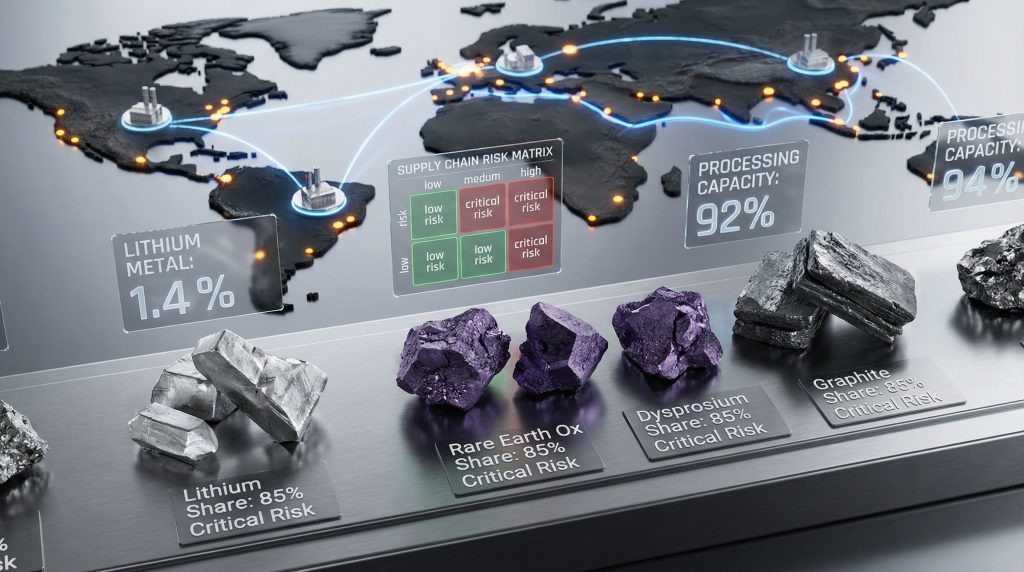
China currently dominates global mineral processing, accounting for 100% of the world's processing capacity for natural graphite and dysprosium, more than 90% for manganese, 70% for cobalt, nearly 60% for lithium, and 40% for copper.
For Mongolia, constraints in basic energy infrastructure currently limit its ability to provide processing plants with a continuous and reliable power supply. In addition, flawed government policy decisions, a lack of policy continuity, and frequent changes to the legal and regulatory environment are sending signals of political risk to international markets, making it increasingly difficult for Mongolia to attract investment.