Эрдсийг эрдэнэст
Ирээдүйг өндөр хөгжилд
Ирээдүйг өндөр хөгжилд
Mining The Resources
Minding the future
Minding the future

By B. Tugsbilegt
Since 2010, Mongolia's coal industry has grown rapidly and come to play a leading role in the country's exports. In some years, coal exports have doubled or even tripled, driving a sharp acceleration in economic growth.
But as we have seen, the budget tends to expand dramatically along with the coal boom. Economies thrive on stable, steady growth, and public finances are no different. They do not respond particularly well to sudden expansion. The reason is simple: sharp increases in spending are often followed by large budget deficits and rising inflation.
The government has always had a tendency to increase spending, and this became particularly pronounced from 2022 onward. Since Mongolia transitioned to a market economy, the country has gone through three major surges in coal export revenues. These cycles have been a key force behind both sharp accelerations in economic growth and periods when growth has slowed.
It may seem overly simplistic to explain everything through coal, but the coal boom has not only driven GDP growth. It has also encouraged politicians' tendency to overspend. This, in turn, has pushed government spending higher and ultimately led to budget deficits- a pattern that has become particularly clear this year.
In other words, the coal sector has its ups and downs. Politicians' enthusiasm for spending, however, does not fade quite so easily. A budget deficit is a sign of faulty calculations, and blaming coal for "failing to deliver" is hardly a valid excuse. The current situation is instead a sign that politicians have placed far too much weight on coal.
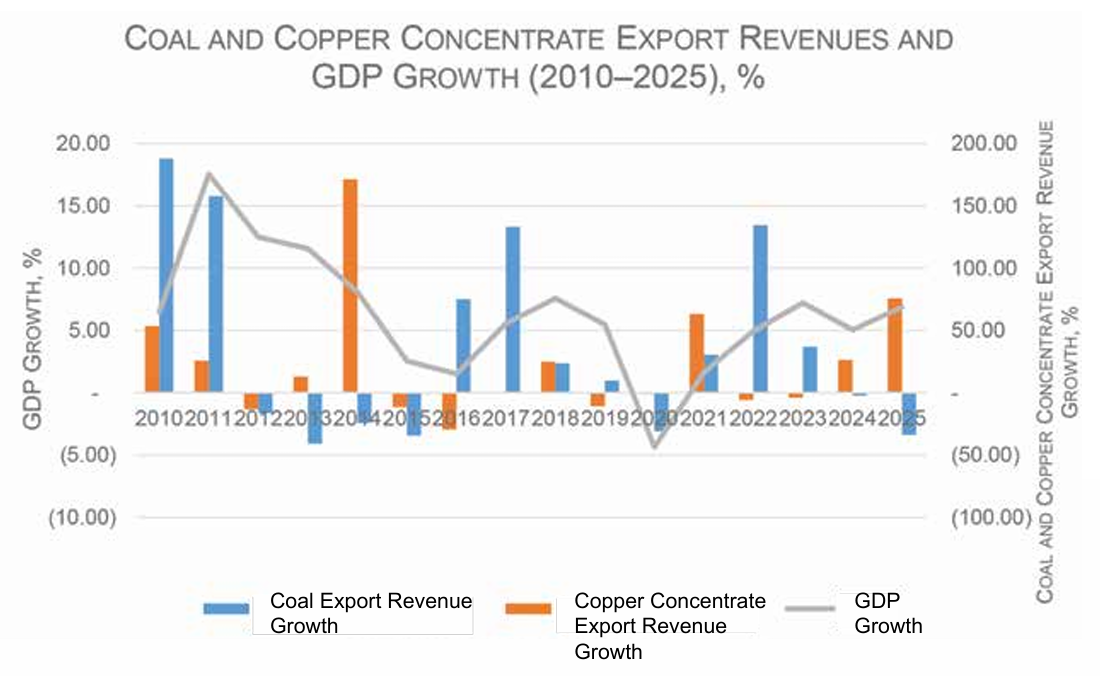
This coal-driven syndrome is currently in full swing. The latest major coal boom of 2022-2023 has begun to lose momentum. Yet our politicians remain firmly convinced that another surge in coal exports is just around the corner.
In reality, however, coal exports have yet to show particularly strong growth, and the question now is whether they can even maintain a steady pace of expansion. Despite this, the rapid expansion of the budget shows no sign of slowing.
One positive outcome of the 2010-2011 coal boom was a significant increase in local government budgets.
More specifically, from 2013 onwards, provincial and local government budgets grew substantially, providing far greater resources for local development while also improving the distribution of revenues. This period was followed by a slowdown in coal export revenues, with growth eventually coming to a halt.
The next upturn began in 2016. Although it was not as strong as the previous boom, the coal industry regained its footing and confidence began to return. From 2019, however, the budget began expanding much more rapidly, followed by an extraordinary surge in government spending from 2022 onward.
Although growth in coal export revenues has slowed, the syndrome of rapid budget expansion has not gone away. This year, coal export revenues are expected to rise by around 60% following their decline in 2025, while a supercycle in Oyu Tolgoi's export revenues is also helping to ease the pressure.
Even so, the government has acknowledged that the budget deficit is widening and that the situation could become more difficult towards the end of the year.
It is also important to bear in mind that the peak phase of investment in Oyu Tolgoi is coming to an end.
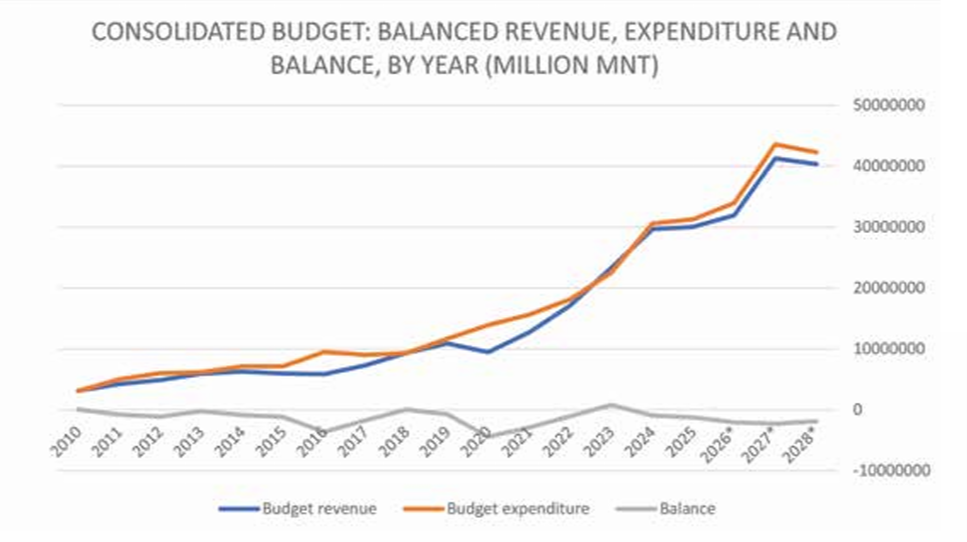
A widening budget deficit carries the risk of increasing the country's external debt burden.
As Mongolia's economy continues to grow, external debt may not appear particularly high when measured as a share of GDP. However, the continued rise in the total amount of external debt deserves particular attention.
This issue is clearly highlighted in the 2027 Fiscal Framework Statement. It notes that Mongolia's external debt burden is expected to increase further and stresses the need to attract foreign investment and boost foreign currency inflows.
The World Bank has also pointed out that, as the development of Oyu Tolgoi nears completion, investment inflows associated with the project are expected to decline.
Against this backdrop, Mongolia has increasingly sought to court investors on multiple fronts. At the end of the spring parliamentary session, lawmakers adopted the country's first Law on Economic Freedom, which the government believes will provide a significant boost to capital inflows.
In addition, the Interim Trade Agreement between Mongolia and the Eurasian Economic Union officially entered into force on July 22.
Although coal and copper exports are performing exceptionally well, it is striking that the budget deficit has already begun to swell barely halfway through the year. The situation was soon compounded by fuel shortages that emerged in late July and continued into August, serving as a stark reminder of the state of Mongolia's economy and the challenges that lie ahead.
The Ministry of Finance has reassured itself with forecasts showing the budget deficit gradually declining. Some government spending can, of course, be reduced by cutting lesser essential expenses. But other costs are becoming increasingly difficult to reverse - including public-sector wages and government funding for the Social Insurance and Social Welfare funds. Their continued growth is a sign that the government's basic spending commitments have already expanded.
The same applies to fuel and energy. As the economy expands, the amount we purchase and consume naturally grows with it. Mongolia's position as a small economy, a small buyer and a small supplier is gradually beginning to change. Under these circumstances, we need a more thoughtful and forward-looking approach, with economic and fiscal policies focused on creating greater stability.
Although mineral exports have reached record highs and continue to grow, there has been little improvement in household purchasing power. In response, the Zandanshatar government submitted a bill to increase VAT refunds. However, the Uchral cabinet later decided to scrap the measure when it approved the 2027 Fiscal Framework Statement.
For the government, VAT remains the largest and most stable "cash cow" for budget revenue, and the authorities do not yet appear willing to give up this source of income.
In place of higher VAT refunds, the Prime Minister announced amendments to tax laws as a "gift" aimed at appeasing the public. The legislation, adopted toward the end of the spring parliamentary session, provides a full exemption from the 10% personal income tax on wage income equivalent to the minimum wage.
The government has, of course, presented the changes as business-friendly, pointing to a higher VAT registration threshold for businesses and more favorable income tax brackets.
Amid these difficult domestic and external economic conditions, the government submitted a revised 2026 budget to Parliament on August 20. At the same time, it announced a new round of spending cuts aimed at saving 1.4 trillion MNT.
However, under the proposed revised budget, spending this year is set to increase by around 1 trillion MNT, while the budget deficit is projected to reach 2 trillion MNT - nearly double the amount approved late last year.
Yet despite all these efforts to cut costs, both government spending and the budget deficit continue to grow. The government attributes this to the need to build strategic food reserves, raise wages and pensions, and contain rising energy prices. It argues that these measures will help protect the public from higher prices.
Key Measures Under the Revised Budget
1.4 trillion MNT in savings under the revised 2026 budget will be achieved by cutting spending on official travel, training, advertising, furniture and equipment, vehicles and machinery, consulting services, allowances, bonuses, conferences and forums, celebrations, and excess transportation and fuel costs.
The savings will come from:
Total: 1.4409 trillion MNT
The savings will be reallocated as follows:
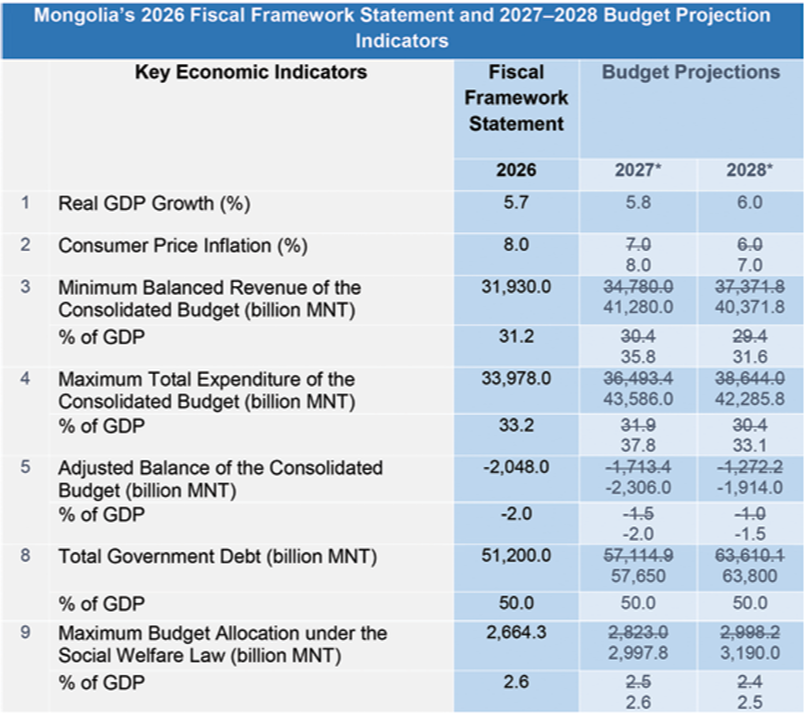
However, the key question of why the budget has fallen so far short has not been clearly or directly explained by the Ministry of Finance. The Ministry has attributed the shortfall mainly to using this year's budget to cover outstanding obligations from the previous year, as well as funding shortfalls for teachers' and doctors' salaries.
However, the Fiscal Stability Council's report on budget execution for the first half of the year noted that corporate income tax revenue had fallen the furthest short of its target.
As of the first half of the year, balanced budget revenue stood at 14.6 trillion MNT, while expenditure reached 16.8 trillion MNT, resulting in a budget deficit of 2.1 trillion MNT. The report noted that 60.3% of the total deficit was attributable to corporate income tax revenue falling short of its target.
The Ministry of Finance stated that, if the current situation persists, the government could face difficulties in paying wages and pensions and financing its operations by the end of the year. It said this was why it had submitted the proposed revised budget.
However, this widening deficit serves as a stark warning that it is time to rethink the approach of conducting abstract economic analysis and making overly optimistic budget projections. In other words, the real causes of the revenue shortfall have yet to be properly diagnosed.
It is not sufficient to explain everything by arguing that tax collections tend to pick up toward the end of the year while they are typically weaker at the beginning. Given that coal export volumes have been particularly strong this year, while copper and gold prices have reached record highs, the question inevitably arises: were expectations for budget revenue simply set too high?
Fuel supply disruptions and the risk of further price increases could fundamentally alter the country's economic outlook. The decline in fuel supplies that began in June had still not been resolved by mid-August. Although the relevant ministry says it is working to restore supplies to normal levels, imports of Al-92 gasoline have not increased significantly, while diesel imports have also shown signs of declining.
Some international media outlets have suggested that Mongolia's coal exports could decline as a result of the fuel shortage.
For now, however, coal export volumes continue to show relatively strong growth. At the same time, fading hopes for the resumption of shipping through the Strait of Hormuz, coupled with mounting disruptions at Russian oil refineries, suggest that fuel prices are unlikely to decline.
Although Mongolia is planning to import fuel from third countries, securing petroleum products in large volumes may prove difficult and could also lead to a sharp rise in fuel prices. This, in turn, raises the risk of inflation spiraling out of control.
According to the National Statistics Office's report on Mongolia's socioeconomic conditions for July this year, inflation has reached 13% year-on-year. Price increases in food and other goods categories ranged from 14.2% to 25.5%. The government, however, aims to keep inflation within the 6-8% range.
Prime Minister N. Uchral stated, "Growth in coal exports and the mining sector remains stable, but inflation is eroding the benefits of that growth."
Finance Minister Z. Mendsaikhan also emphasized that difficult global economic conditions, along with disruptions in fuel supplies from Mongolia's main supplier, are putting additional pressure on the economy.
The main risks in the second half of the year will undoubtedly remain fuel supply constraints and persistent inflation. Although the government is taking measures to curb inflation, food price increases are likely to accelerate in the final months of the year as planned wage and pension increases take effect.
The prices of fuel and other petroleum products, as well as food prices, are increasingly likely to rise further, while fuel availability could become more constrained as shipping disruptions persist along key global trade routes, including the Strait of Hormuz, the Bab el-Mandeb Strait, and Black Sea shipping routes.
Under these circumstances, if the momentum of coal exports can be maintained, budget revenues could still be collected relatively close to target by year-end.
The government's measures to build strategic reserves are an appropriate step to mitigate potential adverse impacts.
However, the revenue outlook could become more challenging in the coming years. Moreover, as election years approach, fiscal discipline is likely to weaken, while inflation and the budget deficit are expected to rise.